chatgptdeepseekai-agenttechnologyllm
Intelligence Finally Got Cheap: What DeepSeek V4 Flash 0731 Means for Agentic Workflows
Parminder PoonianAugust 11, 20266 min read

Intelligence Finally Got Cheap: What DeepSeek V4 Flash 0731 Means for Agentic Workflows
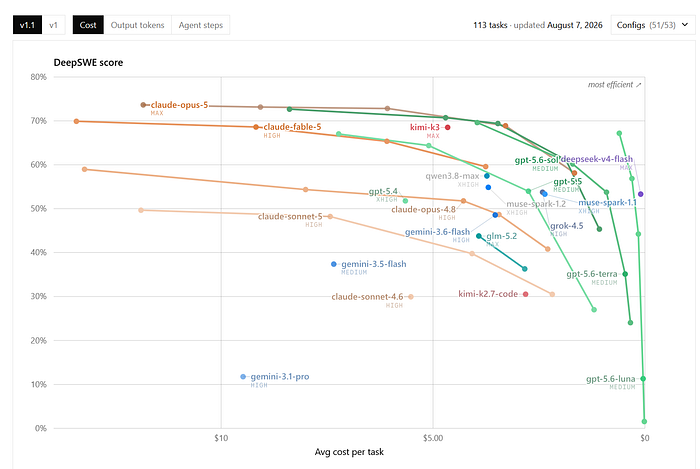 Deepseek V4 Flash on the right — The anomaly in the matrix :)
Cheap models were never the missing piece. DeepSeek’s own V4 Flash preview was cheap, MiniMax’s M3 was cheap, and so was a steady stream of open-weight releases. All of them were easy to ignore because cheap without intelligence is a frustrating model that you would avoid. Smart models existed too, but their price made them something you rationed to avoid hitting the usage quota limits.
DeepSeek V4 Flash 0731 is one of the clearest examples of a model splitting that difference on the intelligence index: near-frontier agentic scores at a dirt-cheap price. The market has adopted it so fast, it is probably part of every automated agentic workflow now.
Deepseek V4 Flash on the right — The anomaly in the matrix :)
Cheap models were never the missing piece. DeepSeek’s own V4 Flash preview was cheap, MiniMax’s M3 was cheap, and so was a steady stream of open-weight releases. All of them were easy to ignore because cheap without intelligence is a frustrating model that you would avoid. Smart models existed too, but their price made them something you rationed to avoid hitting the usage quota limits.
DeepSeek V4 Flash 0731 is one of the clearest examples of a model splitting that difference on the intelligence index: near-frontier agentic scores at a dirt-cheap price. The market has adopted it so fast, it is probably part of every automated agentic workflow now.
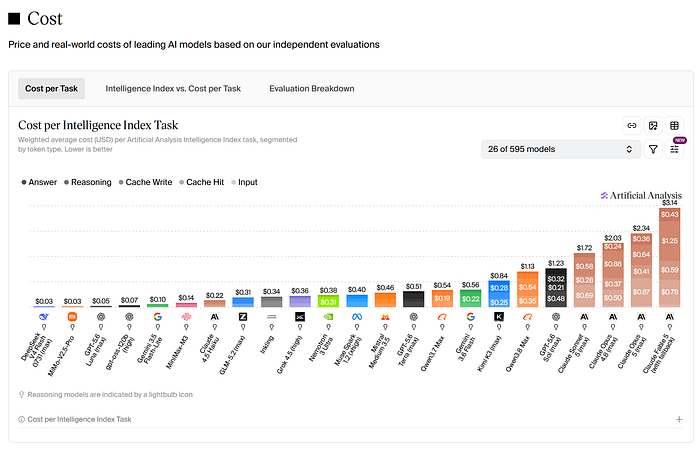 Cost per task on benchmarks compared to all flagships. Deepseek is the cheapest right now!
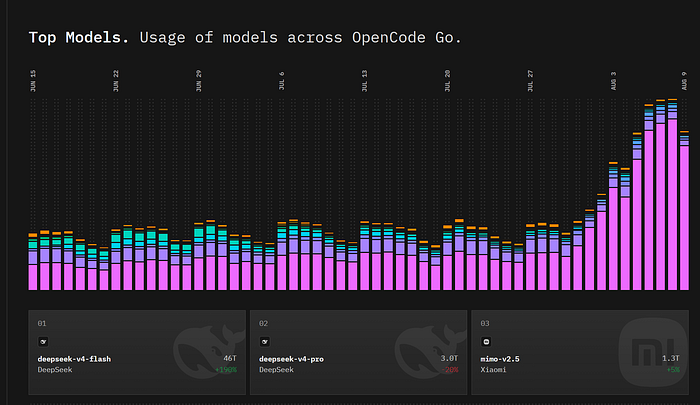 OpenCode Go’s model usage, nothing even comes close
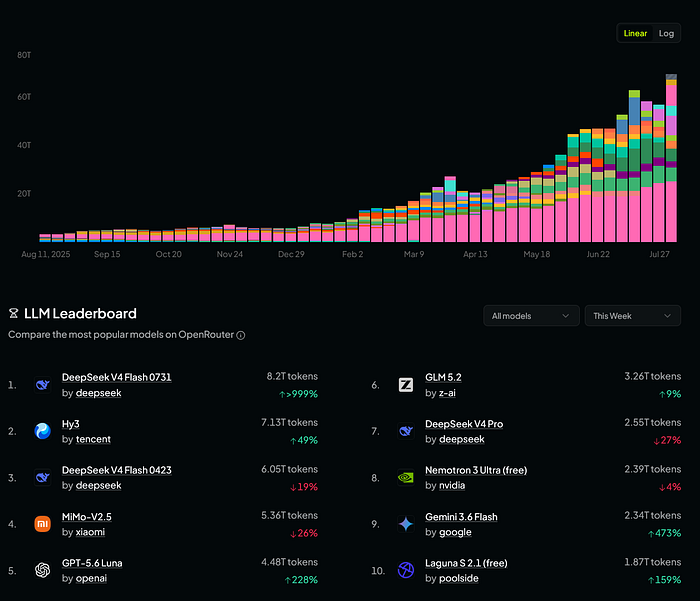 OpenRouter showing an astonishing >999% increase in usage!
On expensive models, teams run agents sparingly, a few tasks here and there with one eye on the meter. This gets annoying quickly.
A task is never one prompt, it’s forty to sixty calls, and every one of them re-sends a context window that has grown a little since the last turn. At $0.40 to $3 per index task; higher cost usually makes teams hesitant in using them as every company is not implementing AI budgeting. DeepSeek V4 Flash removes that hesitation and this will make AI adoption way better.
OpenRouter showing an astonishing >999% increase in usage!
On expensive models, teams run agents sparingly, a few tasks here and there with one eye on the meter. This gets annoying quickly.
A task is never one prompt, it’s forty to sixty calls, and every one of them re-sends a context window that has grown a little since the last turn. At $0.40 to $3 per index task; higher cost usually makes teams hesitant in using them as every company is not implementing AI budgeting. DeepSeek V4 Flash removes that hesitation and this will make AI adoption way better.
What V4 Flash is and how does it do it?
Flash is the small sibling in DeepSeek’s V4 family: a Mixture-of-Experts model with 284 billion total parameters and 13 billion active per token, open weights under the MIT license. The headline spec is the context window. One million tokens is the default across DeepSeek’s official services, about 1,500 pages of A4. A million-token window lets you hand the model vast amount of context from code, documents and RAG. So the engineering effort moves from retrieval tuning to building better prompts. The architecture matters because it explains the price. Long context is costly to serve. DeepSeek’s hybrid attention stack, compressed sparse attention combined with heavily compressed attention, keeps a million-token window cheap enough to store. At one million tokens, V4 Pro needs 27% of the per-token inference FLOPs and 10% of the KV cache of V3.2. Flash has the same design with lesser number of experts. DeepSeek’s training runs in two stages, training domain experts separately with supervised fine-tuning and reinforcement learning before merging them into one model through on-policy distillation. This means that first you make lots of models that are expert in finance, coding, writing and then you train a generic student model that learns from the teachers. The result is a set of specialists squeezed into one set of weights.
The number that matters
On the intelligence index, the 0731 release scores 52. The median for comparable open-weight models is 26. The same release scores 79 on SWE-bench Verified and 56.9 on Terminal Bench 2.0, and beats the earlier V4 Pro preview on agentic coding, a model roughly five times its size. Models with similar or lower scores, MiniMax M3, Kimi K3 at low effort, GLM-5.1, cost about ten times more per index task. The ones that beat it, Grok 4.5, Gemini 3.6 Flash, Claude Opus 5, GPT-5.6 Sol, need $0.40 to $3 per task compared to Deepseek’s 0.03$.
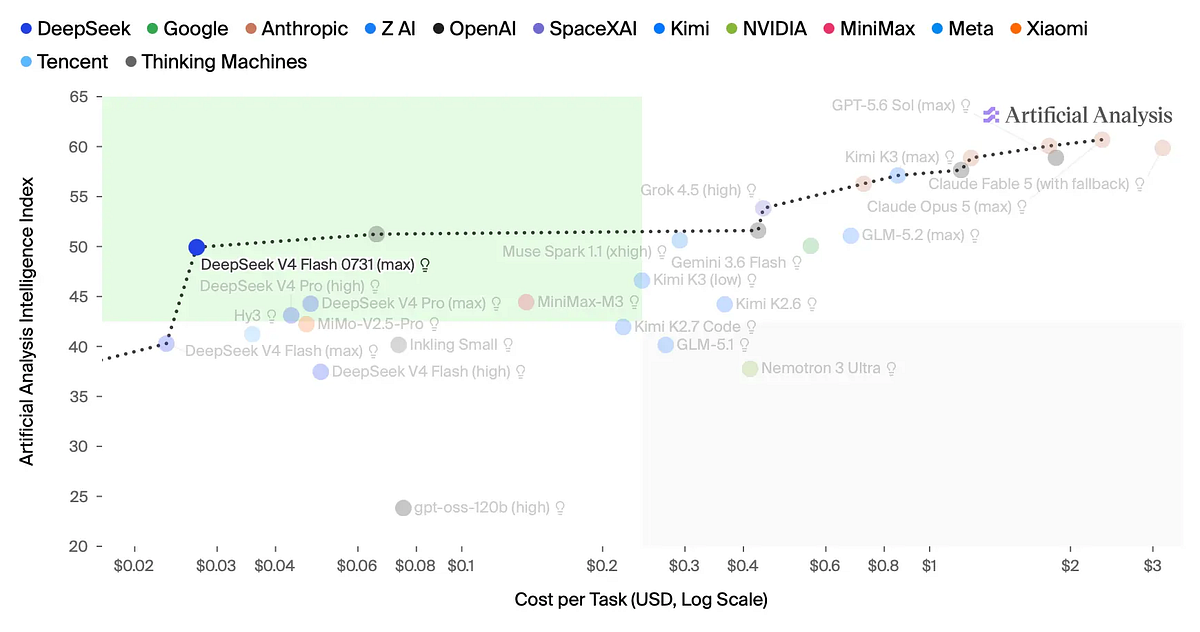 Flash sits alone where the curve bends, surrounded by models ten times costlier at the same score or five to a hundred times costlier for a few extra points. It is a position no other lab sits in.
What Flash still can’t do
Before the argument gets too neat, here is the best case against it. Flash has real limits, and they set where you should and shouldn’t use it.
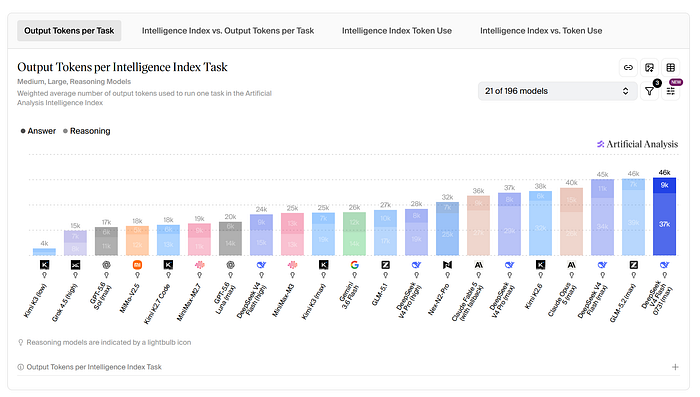 Deepseek has the highest output tokens of all benchmarked models.
The most practical limit is verbosity. It talks a lot: in the intelligence index run it produced 210 million output tokens against a median of 100 million for comparable open models. Although still it is still very cheap because of its architecture and inference efficiency.
Then there’s the knowledge ceiling. Parameter count stores world knowledge, and Flash’s smaller scale still trails on pure knowledge tasks and on the hardest agentic workflows. Flash needs tools and MCP servers to make it thrive with its lesser number of parameters.
It’s text-only too: no image input, so pipelines that depend on screenshots, diagrams, or document images need another model. And DeepSeek announced a peak-hour surcharge tied to Beijing business hours but hasn’t switched it on; the old API aliases stopped resolving on July 24, which already forced every production integration to choose Flash or Pro.
None of this undermines its importance! It just marks the boundary of its abilities: Flash is necessary just not able to take up every task yet.
Deepseek has the highest output tokens of all benchmarked models.
The most practical limit is verbosity. It talks a lot: in the intelligence index run it produced 210 million output tokens against a median of 100 million for comparable open models. Although still it is still very cheap because of its architecture and inference efficiency.
Then there’s the knowledge ceiling. Parameter count stores world knowledge, and Flash’s smaller scale still trails on pure knowledge tasks and on the hardest agentic workflows. Flash needs tools and MCP servers to make it thrive with its lesser number of parameters.
It’s text-only too: no image input, so pipelines that depend on screenshots, diagrams, or document images need another model. And DeepSeek announced a peak-hour surcharge tied to Beijing business hours but hasn’t switched it on; the old API aliases stopped resolving on July 24, which already forced every production integration to choose Flash or Pro.
None of this undermines its importance! It just marks the boundary of its abilities: Flash is necessary just not able to take up every task yet.
What changes when smart gets cheap
The most visible change is in usage. Budget subscriptions used to mean quota anxiety: a $10-a-month plan on an agentic coding tool bought a few hours of serious work before the wall. On Flash-class economics the same subscription buys a lot more: background agents, long-running loops you’d never have started because the meter was running. Deepseek Flash brought a kill zone on the benchmarks. V4 Flash is cheap and, on the intelligence index close to frontier on agentic work. That puts every model that is more expensive and less intelligent in a bad position, and there are a lot of those. Labs that held their rate cards steady are starting to cut prices.
How to get the most out of DeepSeek V4 Flash
Flash works best as a high-volume worker for text-heavy agent jobs. Always use DeepSeek flash with max reasoning effort because it is so cheap that it hardly matters if it is max, high or low. Use it to create loops or tooling workflows to automate testing, small bugfixes and exploration tasks. Get OpenCode Go subscription to get the best value for your money, it is 5$ first month followed by 10$ per month. It gives you 60$ of Deepseek V4 Flash usage, which is near infinite for any workflow you throw at it. Along with that you also get access to GLM 5.2 and Minimax M3 for your planning tasks. Here is a referral link to get 5$ extra usage! https://opencode.ai/go?ref=DVSQ1FRQYA
If you found this article insightful then please like and comment your thoughts. I would love to know how you all are using DeepSeek in your workflows! Surely I’ll get some inspiration too :)
(Disclosure: Some of the research and thus the text was collated by AI tool which was later edited by me. To ensure correctness, some proofreading was also AI assisted.)
Ready to put this into practice?
Book a 1:1 mock interview with a FAANG engineer, or work through free interview questions with a live code editor.